Project Context
Edinburgh High Court is a prominent civic building within Edinburgh’s Old Town, a UNESCO World Heritage Site. Constructed in 1936, the four-storey, B-listed building spans 5,232 m² and operates as a live judicial environment, supporting Scotland’s justice system and overseen by the Scottish Courts and Tribunals Service.
OCS was engaged to support the early stages of the building’s low-carbon journey. The focus was on establishing what could realistically be achieved within the constraints of heritage protection, operational continuity, and public-sector investment requirements.
The Challenge
The building had relatively poor energy performance, with an EPC rating of D (58), ageing services infrastructure, and limited insight into how energy was being consumed or wasted. Any improvement programme needed to respect listed-building status, avoid visible external alteration, and be delivered without disrupting court operations.
Capital funding was also uncertain. A robust evidence base was required to justify investment, demonstrate value for money, and align proposals with the Scottish Government’s funding criteria.
Our Discover approach
OCS delivered a structured discovery programme focused on insight, viability, and fundability. This included:
- Detailed energy audits and technical surveys covering building fabric, lighting, ventilation, controls, and electrical systems
- Analysis of energy use, carbon performance, and operational patterns across the live estate
- Identification of planning, conservation, and operational constraints
- Establishment of a clear performance baseline to support future measurement and verification
- Alignment of potential interventions with Scottish Government low-carbon funding requirements
This ensured the discovery phase was grounded in what could be approved, funded, and delivered in practice.


Identifying Where Impact Could be Delivered
The discovery work confirmed that meaningful reductions in energy use and carbon emissions were achievable when interventions were carefully aligned with heritage constraints, operational requirements, and funding criteria.
Rather than pursuing invasive or high-risk solutions, the focus was on measures that could deliver measurable impact while protecting the building’s historic fabric and maintaining a live court environment.
Priority opportunities included:
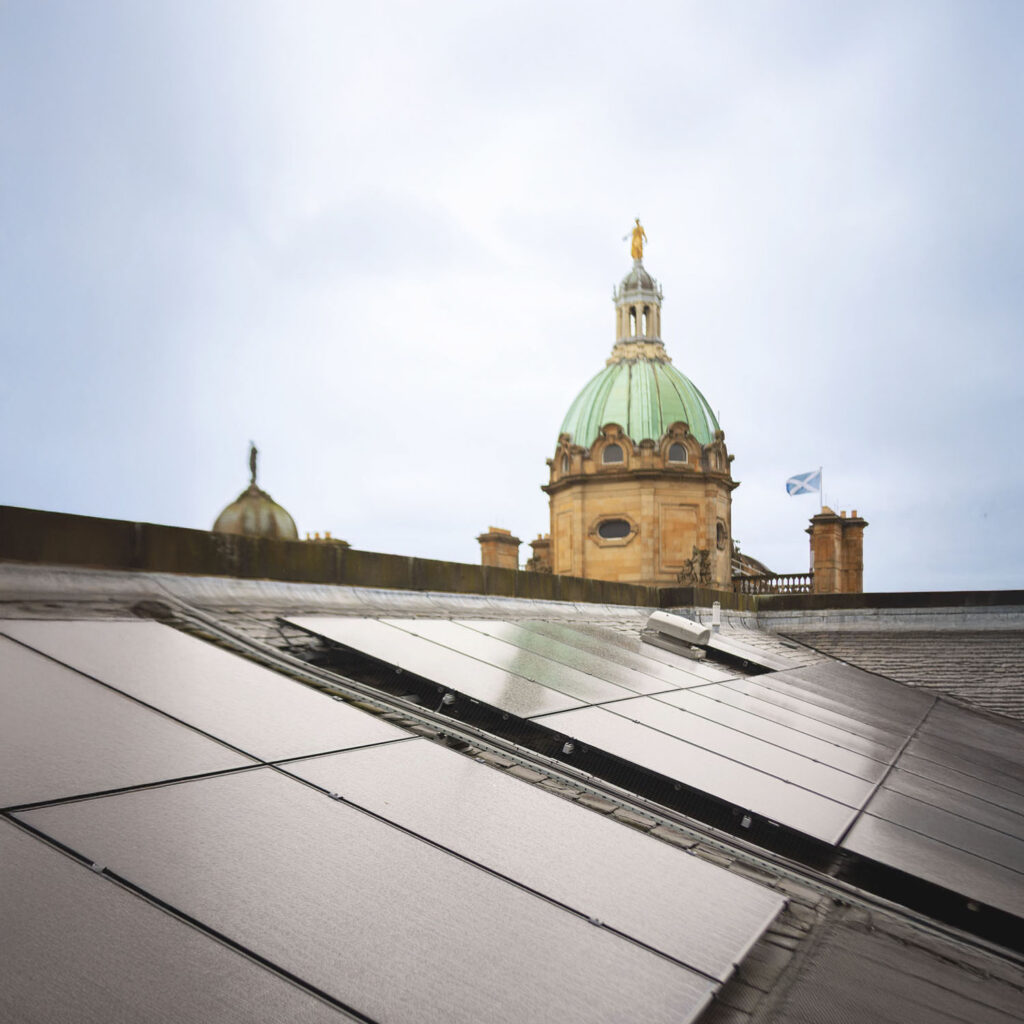
- Roof-mounted solar PV positioned outside public sightlines to enable on-site generation without visual impact
- Advanced vacuum glazing compatible with traditional sash and case windows, reducing heat loss while retaining historic fabric
- LED lighting upgrades with presence detection in corridors and stairwells to lower electricity demand
- Improved ventilation control through enhanced temperature and CO₂ sensing and optimisation of existing BMS strategies
- Circuit-level electrical metering to improve visibility of consumption and identify out-of-hours energy waste
Together, these measures formed a coherent, low-risk programme that was planning-compliant, operationally safe, and capable of delivering measurable performance improvement.
Outcome
The discovery programme provided the Scottish Courts and Tribunals Service with a robust, evidence-led platform for decision-making. Following this work, OCS developed and submitted a funding application to the Scottish Government, securing £2.1 million in grant funding to support the low-carbon retrofit programme.
The work also gave the customer confidence in the scope, sequencing, and viability of the proposed measures, enabling a clear transition from discovery to detailed design and delivery.
Key Metrics
- £2.1 million secured in Scottish Government grant funding
- Clear energy and carbon baseline established to support measured savings
- Predicted total energy reduction of up to 30 per cent
- Investment-ready programme approved for progression to design