

Now, at the start of 2026, the Big Carbon Kickout initiative has reached a key milestone. Enough time had passed to step back from delivery and look properly at what a full calendar year had shown. For Matthew Vernon, Executive Development Chef, the conversation was no longer about launching an idea or testing whether it could work. It was about understanding what actually happened across 2025 and what those results revealed when viewed together.
The figures provide a clear starting point. Over the year, Big Carbon Kickout delivered carbon savings of 94,513.83 kg CO₂e. That equates to around 240,685 miles driven in an average petrol-powered car. Across OCS sites, 36,371 lower-carbon dishes were sold.
Those numbers matter, but Matthew is clear that they are a starting point rather than a conclusion. What mattered more was how they came about and what they revealed about behaviour, kitchens, and customer choice.
Seeing the Scale Over Time
Month by month, the data never felt abstract. Each reporting cycle showed progress, but it was incremental. Some sites sold only a handful of dishes, while larger sites sold many more.
“When you look at one site, it might not feel like much,” Matthew says. “But when you total it up across around 300 sites over twelve months, that’s when the scale really hits.”
Seeing the full-year figure changed how the initiative was perceived. What felt modest in isolation became meaningful in aggregate. For Matthew, that moment validated the quiet effort happening across kitchens, where small, consistent changes were being made every day.
What Worked With Customers
One of the clearest lessons from 2025 came from customer feedback. Big Carbon Kickout worked because it focused on replacing familiar dishes rather than introducing alternatives that required people to change their habits.
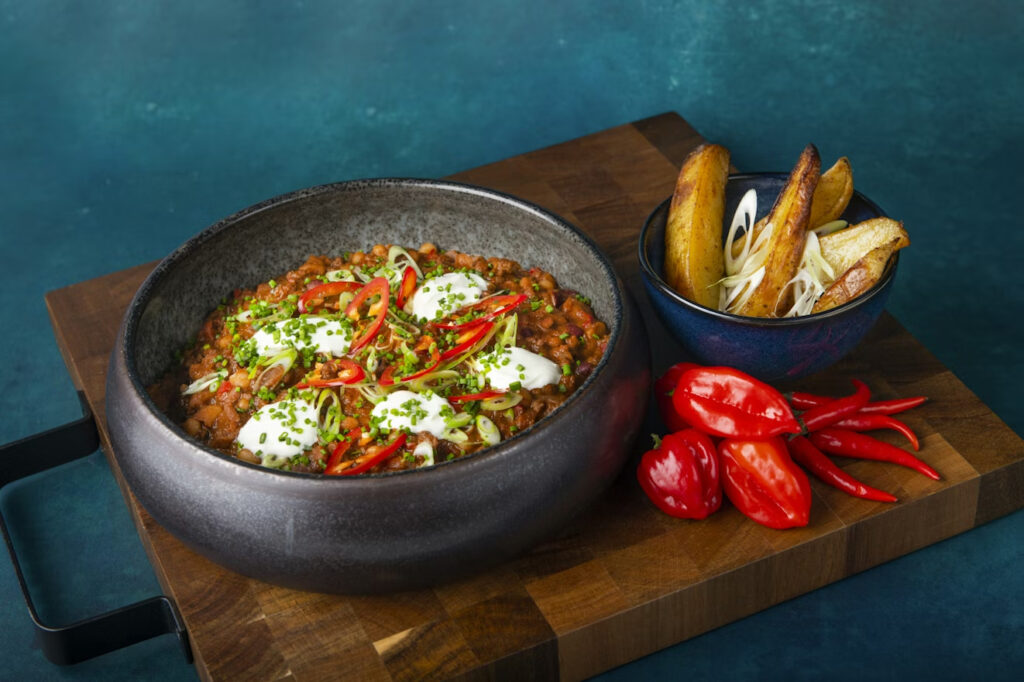
Popular meals such as lasagne, cottage pie, and beef chilli were reformulated following taste tests and feedback. The original versions were removed and replaced with enhanced recipes that reduced carbon emissions while maintaining flavour, portion size, and value.
“These are dishes people know well,” Matthew explains. “They come with expectations, so I wasn’t completely convinced at the start that customers would accept the change.”
In practice, they did. Uptake remained strong, and repeat sales were a clear signal of success. Customers returned because the food delivered what they expected from a good meal. The carbon saving sat alongside that experience rather than driving it.
The hybrid burger became an early reference point for this approach, particularly during summer barbecues. It was a direct replacement for a familiar staple, not a new concept. By reducing the beef content and blending it with plant-based protein, each portion reduced carbon emissions by around 1.66 kg CO₂e, while still providing 16 g of protein per 100 g, lower saturated fat at 3.6 g, added fibre to support gut health, and an allergen-free profile. Its success reinforced a simple lesson. When sustainability is built into something people already enjoy, uptake follows naturally.
Over time, the changes stopped being noticed. The new versions became the norm, which was one of the strongest indicators that the approach was working.

Patterns in the Data
Looking at the full year revealed patterns that closely aligned with operational reality. Sales were lower during the quieter months of January to March, when workplace footfall drops and spending habits tighten. December also dipped, influenced by seasonal closures.
From April onwards, uptake increased sharply. Spring and summer brought renewed momentum, with numbers nearly doubling compared with early-year figures. July, September, and October were peak months, driven in part by barbecues and seasonal events.
“Barbecues are traditionally where meat consumption is highest,” Matthew says. “So when you replace part of that, that’s where you see the biggest reduction.”
The data reinforced what teams were seeing day to day, giving confidence that operational experience and reporting were aligned.
Making Carbon Understandable
Another learning from the year was how carbon savings were communicated. Kilograms of CO₂e are difficult to visualise, even for people who care about sustainability. Mileage equivalents changed that. Comparing savings to the distance driven in a petrol-powered car made the impact tangible and immediate.
“When you say a dish saves the equivalent of driving from London to Milan, people get it,” Matthew explains. “It turns an abstract figure into something real.”
That approach also helped to open up wider conversations about food and carbon, particularly around the impact of beef, which is less well understood than transport emissions.
What the Year Taught Us
The Big Carbon Kickout initiative has shown that behaviour change does not need to feel forced. Customers did not have to abandon their preferences or make conscious sacrifices. The saving was built into the dish.
“They could just enjoy a good meal and know something better had happened as a result,” Matthew says.
For kitchens, the initiative aligned sustainability with commercial reality. Reducing the proportion of high-cost ingredients freed up space to improve recipes rather than strip them back. Portion sizes were maintained. Value for money was protected. In some cases, gross profit improved, giving managers a practical reason to continue.
Sustainability became integral to delivering good food, not a trade-off against it.
Looking Ahead With Confidence
A full year of data has changed the nature of conversations with customers. Evidence now replaces assumptions. Results now replace intent.
For Matthew, the hope is simple. That colleagues feel supported in delivering food that works operationally. That customers feel informed without feeling pressured. And that the first year of Big Carbon Kickout is remembered as a practical example of how everyday choices, made well, can add up to meaningful change.
As he reflects on 2025, Matthew Vernon returns to the same principle. Good food comes first. When sustainability supports that principle rather than competing with it, progress follows naturally.