
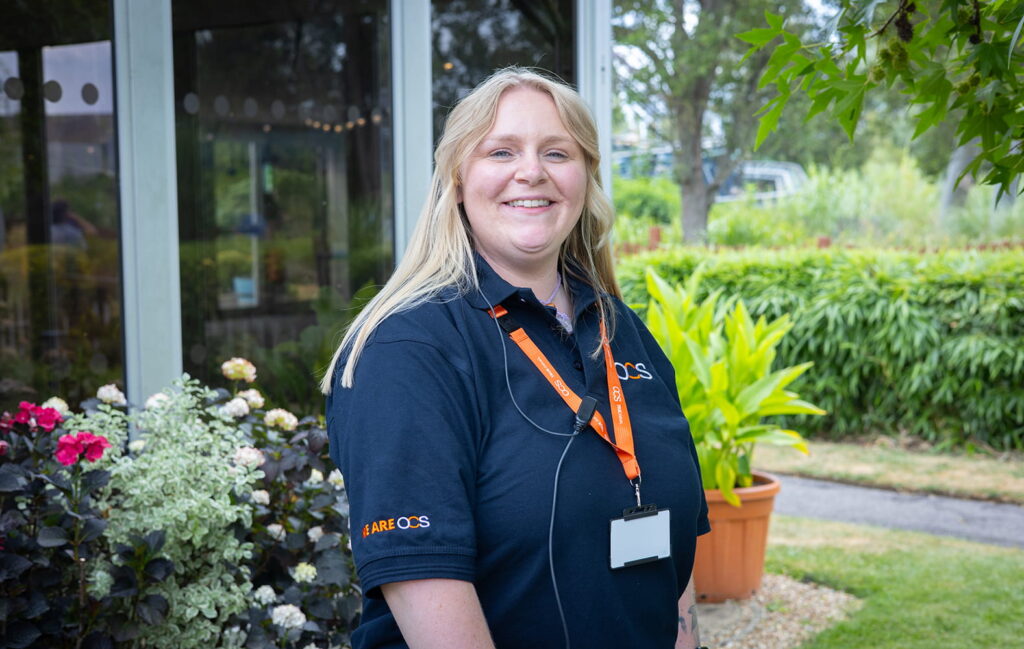
Security is often seen as protection first. Michelle Elmore has spent 42 years proving it is really about people.
Michelle Elmore is an OCS Security Officer at HM Courts & Tribunal Service in Birmingham, where she screens and searches everyone coming through the doors, keeps order in a building where emotions often run high, and steps in whenever a situation threatens to turn. It is frontline security work in every sense, keeping colleagues, court staff and the public safe, but what makes Michelle stand out is the way she does it. Rather than meeting tension with force, she heads off trouble with a conversation, reading people long before a problem becomes an incident. She has been doing it for 42 years and five months, and this September that lifetime of work will be recognised as a finalist for the Frontline Award at the Women in Security Awards. The award recognises women working at the very forefront of the security industry, celebrating those whose contribution, professionalism and impact stand out across frontline roles.
Into the Job on Her Own Merit
Security runs in the family, so it was a world Michelle knew well from the very start. “What drew me into it was my family background”, she says. “The majority of them are in the forces.” An uncle who was the chief inspector of North Tyneside wanted her in the police and could easily have opened the door for her, but she was determined to make her own way. “I said, to go into that, I’ve got to do it on my own merit. I’m not going to do it because of who you are.” She started out in 1984 on her own terms, and more than four decades later she has never once regretted it.
The years brought promotions, first to supervisor and then to manager, before she made the kind of decision most people never do and chose to step back down to the floor. “I’ve been a manager, I’ve been a supervisor. I don’t want to do that anymore. My best job is on the frontline, meeting and greeting members of the public, keeping them calm.” That is where she has stayed ever since, closest to the people she came into the job to help.
The Skill You Cannot Teach
The courts can be a place of real emotion, and on any given day the people arriving include defendants facing serious charges alongside anxious victims, witnesses and worried families, many of whom walk through the doors frightened or on edge before the day has even begun. Handling all these scenarios takes far more than a watchful presence at the door, and Michelle’s real gift lies in reading a person and easing the tension before it has a chance to build. Some arrive braced for a fight, and she has long since learned to look past the anger to find the person beneath. “The first thing they see is the uniform”, she says. “They don’t see the person beyond that. So first off, you’ll have a bit of a disagreement.” Then, slowly and without ever once raising her voice, she turns it around, and it all rests on a single principle she comes back to time and again. “You talk to people the way you want to be spoken to yourself. No other way.”
It works because she genuinely means it, and because she meets people exactly where they are. “I’m a Black Country girl, and believe it or not, they understand my way of thinking, because I speak like them. If you start talking la-di-da, they aren’t going to listen to you.” Word of that gift has spread well beyond Birmingham, and court managers across the Midlands now ask for her by name, making her their first call whenever they face a protest or a potentially violent person.
When It Matters Most
Some days ask far more of Michelle than a difficult conversation ever could. A defendant once began having a panic attack in the building, and the bench sent straight for her, knowing she would handle it with care. She coaxed him out of the courtroom, talked him down gently, and stopped a police officer from handcuffing him because that was simply not what the frightened young man needed. She rang probation, who came down to help, and before long he was on his way.
The hardest moments are the ones that stay with her. There was the man she found outside court three in tears, who told her that he wanted to end his life, and she sat with him, patiently taking him through every step of the support process before telling him exactly where to find her if he ever needed to talk. He took her word, and she has seen him around the courts many times since, still here.
Then there is the woman she is quite certain she saved. “A lady was having a seizure on the steps, quite aggressively hitting her head, and I put myself between her and the danger. I wouldn’t move, because if I did, it could have been fatal. I knew exactly what to do, because I’m epileptic myself.” A couple of days later the woman came back into the building and asked to see the lady who had saved her, and it is those quiet returns, Michelle says, that make the whole job worthwhile.