OCS entered aviation in 1966 and now supports more than 60 airports and airlines worldwide. Much of that work happens away from the biggest international hubs, at the airports where people begin and end their journeys every day.
Gareth Daniel has spent much of his career close to that reality, joining the Dublin Airport operation in August 2009, shortly after OCS arrived there. We spoke to him about what it takes to keep aviation moving when conditions change, the value of experience built over decades and why ideas developed at regional airports can end up influencing operations around the world.
What makes aviation such a demanding environment to operate in?
“For me, aviation is about understanding that things change every single day. Aircraft arrive late, weather disruption happens, passengers need support, incidents occur, and demand can change quickly. The difference is whether you have the systems, people and experience to manage that proactively.”
Head of Operations – Aviation, OCS Ireland
Airports are rarely tested on a quiet day. They are tested when the weather closes in, an aircraft arrives late, an incident happens and demand spikes, all at once.
Whether an operation absorbs that pressure without the passenger feeling it comes down to preparation that started long before the disruption did.
What does it take to build an airport partnership that lasts?
“We’ve been a partner at Dublin Airport for close to 18 years. You don’t maintain relationships like that unless you’re continuing to evolve, solve problems and support the operation in the right way.
“A lot of my senior team have been here for around 20 years. They have stayed because they are passionate about aviation and experts in their field. That knowledge stays in the business, and it makes a real difference when you are supporting airports, airlines and passengers every day.”
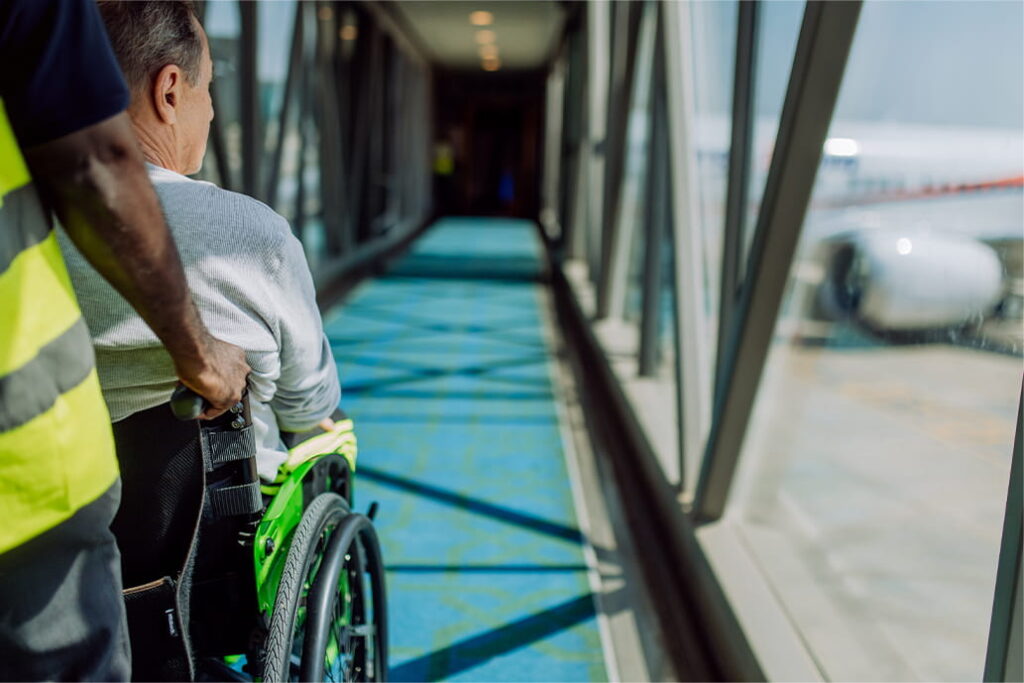
The scale of the Dublin operation is considerable. The airport handles approximately 36 million passengers a year. OCS supports it through passenger assistance and PRM services, hold baggage screening, cleaning and wider aviation support, with passenger assistance delivered in line with EU Regulation 1107/2006 on the rights of passengers with reduced mobility.
“Around 550,000 passengers with reduced mobility travel through Dublin every year, and not one of them experiences our service in isolation; they experience the whole airport, so everything has to work together. That’s why we build the journey around the person: the right technology to be there when we’re needed, and colleagues with empathy to make the experience feel effortless.”
Head of Operations – Aviation, OCS Ireland
Beyond Dublin
OCS Ireland provides regional aviation services at Dublin, Cork and Belfast airports, including hold baggage screening. That work sits within an Irish business that has grown from 1,800 to 3,500 colleagues in four years, strengthening the depth of experience and expertise available across operations.
But holding a consistent standard does not mean treating every airport in the same way.
Regional airports have different passenger profiles, infrastructure and operational pressures. The strength comes from understanding those local differences while giving teams access to knowledge, systems and experience developed elsewhere.
And some of the ideas developed at regional airports have travelled much further.
“Ireland is where some of our best aviation thinking starts.
Our bespoke PRM resource allocation platform was piloted at Cork in 2017, rolled out to Dublin in 2019, and is now used across OCS UK and Ireland. Having grown from 1,800 to 3,500 colleagues in four years, Ireland is a centre of excellence and innovation shaping how OCS supports passengers with reduced mobility globally.”
Managing Director, OCS Ireland
From Cork to the Wider World
A bespoke PRM resource allocation platform was piloted at Cork Airport in 2017 before being rolled out to Dublin in 2019. It has since been adopted across OCS UK and Ireland regional aviation where OCS is not the service provider.
A planning and forecasting platform followed a similar path, piloted at Cork in 2022 and implemented at Dublin in 2023. The approach is now used more widely across OCS aviation operations globally, including in Asia Pacific and the Middle East.
The results at Dublin demonstrate what happens when experience and the right tools work together: forecasting accuracy regularly reaches 95%, overtime has reduced by 50%, aircraft delays by 69%, labour efficiency has improved by 10% and PRM pre-notification by 10%.
A 69% reduction in aircraft delays is not achieved in a single season. It comes from iteration across airports, refinement of the model and the discipline to act on what the data shows.
It also demonstrates that innovation does not have to begin at the biggest airport. An idea tested at Cork can ultimately improve operations thousands of miles away.
The Same Standard, Shaped Around Each Airport
That same principle applies across OCS’s regional aviation operations.
At Edinburgh Airport, OCS delivers assisted travel around the clock. More than 150 colleagues support passengers through different stages of the airport journey, working alongside airport teams, airlines and handling agents to provide assistance when and where it is needed.
The operation achieved a Very Good rating in the Civil Aviation Authority’s latest Accessibility Assessment, with a standard of assistance within 10 minutes at every designated location and support delivered by the same team member wherever possible.
Those operational measures matter because of what sits behind them. Passengers can arrive anxious or unsure about what to expect, and disruption or delays can add to that pressure. Staying calm, listening and adapting to what each person needs is therefore as important as getting someone from one part of the airport to another.
“We know how important this service is to passengers who use it, and we’ve worked closely with OCS to strengthen recruitment, training, equipment and service standards. We remain focused on continuing to deliver a high standard of assistance for our passengers.”
Peter Barnes
Chief Operating Officer, Edinburgh Airport
How important is experience in an industry like aviation?
“We have a big bank of knowledge going back 20 or 30 years. When you’re dealing with airlines, airports and stakeholders, that experience makes a real difference because our people understand the operation, the challenges and what’s needed to make it work.”
Airports will keep changing, and the demands on them will keep rising. The operations that cope are the ones built to adapt, experienced enough to anticipate change, equipped with the right information and disciplined enough to keep improving.
That applies whether an airport handles 36 million passengers or a few hundred thousand.
Because to the person walking through it, the size of the terminal is irrelevant. Their reason for travelling matters just as much.
Regional aviation: Because every journey means something to someone.