
Energy Services | Facilities Management

Rising Heat, Failing Cooling: How FM Keeps Sites Running as the UK Warms

Nick Maggs, Managing Director, Hard Services – OCS UK

Nick Maggs, Managing Director, Hard Services – OCS UK

16 Jul, 2026

Rising Heat, Failing Cooling: How FM Keeps Sites Running as the UK Warms

UK summers now push cooling and refrigeration past the limits they were built for. How facilities management can close the gap before the next heatwave.

The UK is in the middle of another summer of extreme heat. June 2026 was England’s warmest June on record, with a provisional 37.7°C recorded in Norfolk and the Met Office’s first red extreme heat warnings of the year. July has brought a third heatwave. As temperatures climb, supermarket fridges and freezers have been failing, aisles standing empty and spoiled stock cleared before it reaches customers.

Empty freezer cabinets are the visible edge of a deeper problem. Much of the UK’s cooling and refrigeration was designed for a cooler climate, and it is now being asked to work in conditions it was never rated for. When the temperature climbs, cooling stops being a comfort question and becomes a continuity one.

From Heatwave to Systemic Risk

The records keep climbing. The all-time UK high of 40.3°C, set in July 2022, increasingly looks like a preview rather than an outlier, and the Met Office projects the country could reach 45°C by 2056. Without serious adaptation, the Environmental Audit Committee warns, heatwaves could cause up to 10,000 heat-related deaths a year and cost the economy around £60 billion through lost productivity and health impacts.

Cooling demand is climbing with the temperature. Government research projects a sharp rise in cooling loads to 2100, with air conditioning in English homes potentially reaching five million dwellings by 2050. The grid feels this directly. Analysis by Drax shows that above about 20°C, electricity demand rises by roughly 350 MW for every additional degree, driven by air conditioning and refrigeration, and National Grid expects peak load from cooling to triple over the coming decade. During recent heatwaves that demand has arrived just as wind output weakens and evening solar fades, tightening margins enough to trigger Electricity Margin Notices.

For organisations, that combination reads as operational risk: rising energy costs, thinner grid headroom, and equipment running at the edge of its limits on exactly the days when failure is most expensive.

The Hidden Fragility of UK Cooling Assets

Most of the installed base was specified for a cooler Britain. Many supermarket refrigeration systems were designed decades ago for maximum ambient temperatures of around 32°C. Push a store into the mid-30s, and compressors run flat out; efficiency collapses, and breakdown becomes far more likely. The same physics applies to older air conditioning: units rated for 18°C to 25°C ambient struggle when the outside air sits above 35°C.

A cooling and refrigeration plant typically lasts 15 to 20 years. Most of what is running today will spend the rest of its working life in a warmer climate than it was built for. Organisations tend to find this out the hard way, during an event, when the aisle is already bare, or the server room is already too hot.
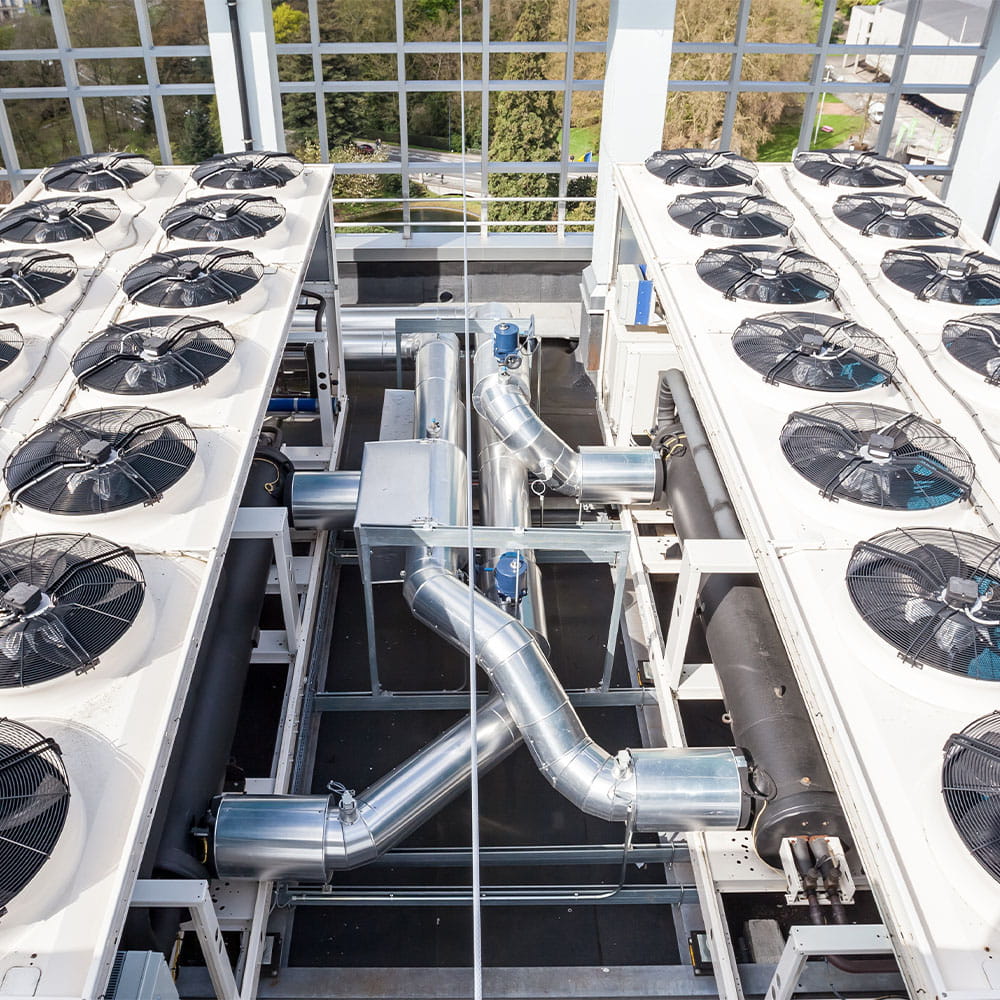
Large rooftop air-conditioning units with multiple fans and exposed silver ducting, seen from above, inside a building with large windows showing trees and a road outside.
A man in a navy OCS polo shirt, with tattooed forearms, stands confidently with arms crossed in front of industrial pipes and equipment wrapped in insulation.

Why Bigger Chillers Are the Wrong First Move

The obvious answer is more cooling: larger chillers, more units, higher capacity. On its own, it is the wrong call. Bigger plants raise energy costs, add to peak demand at the worst possible moment for the grid, increase emissions, and still leave an estate exposed if the underlying assets are poorly maintained or badly controlled.

It also pulls against net zero. At COP28, the UK signed the Global Cooling Pledge, committing to cut cooling-related emissions by 68% by 2050. Meeting rising heat by simply bolting on more mechanical cooling works directly against that goal. Resilience and decarbonisation are two constraints that have to be solved together.

FM as the Steward of Cooling Resilience

Hard services teams already manage HVAC, refrigeration, building management systems and electrical infrastructure on customer sites. Energy services teams already run efficiency and decarbonisation programmes. Heat resilience sits exactly where those two meet. No other function combines a live view of asset health, energy performance, operational risk and occupant safety across a whole estate.

The shift is one of framing. Treat cooling as a strategic asset class, on a par with power, fire safety and IT, rather than a maintenance line that only draws attention when it fails. That means continuous monitoring, planned investment, and a clear map of where a cooling failure costs money immediately and where a few degrees of drift can be tolerated.

Occupant safety belongs in the same frame. There is still no legal maximum workplace temperature in the UK, but HSE is expected to consult during 2026 on how workplace heat is managed, with unions pressing for a statutory limit. Keeping people safe and productive through extreme heat is turning into a duty of care with legal weight behind it.

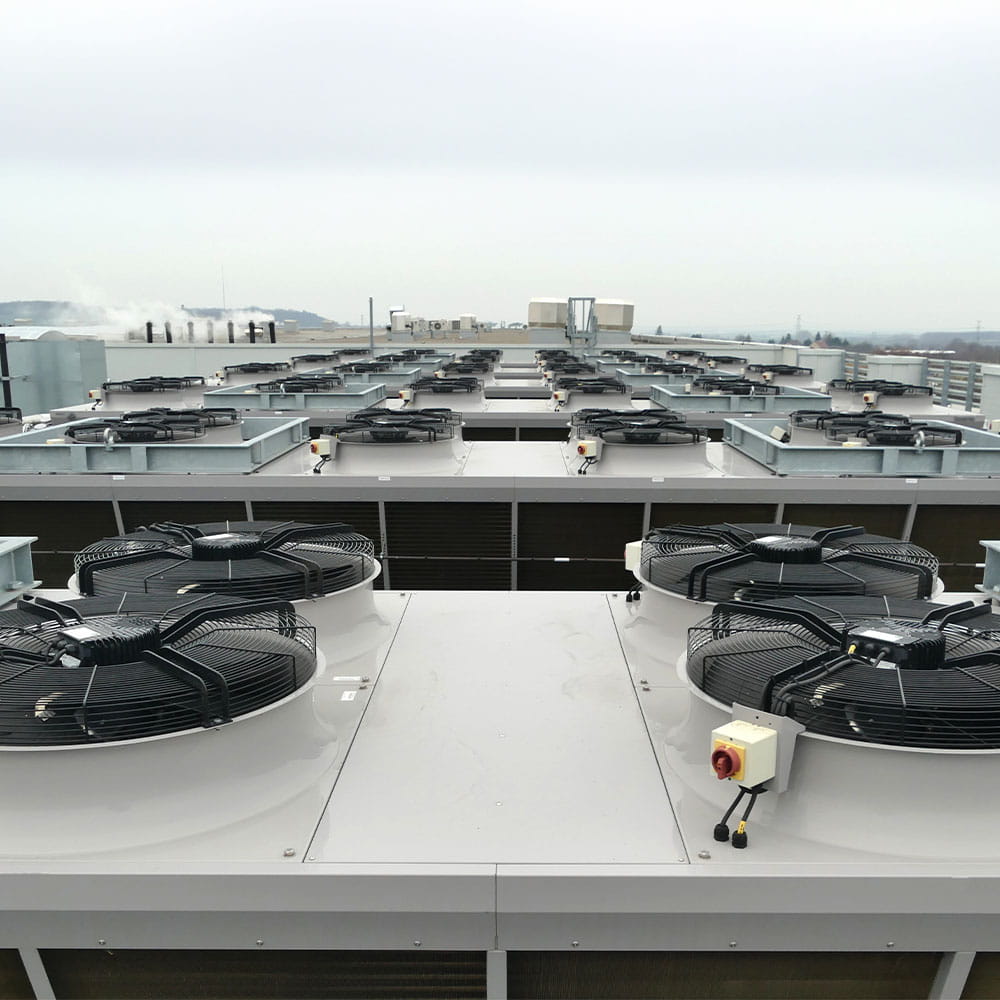
Large industrial HVAC units with multiple circular fans are lined up on a rooftop under a cloudy sky, with distant buildings and chimneys visible in the background.
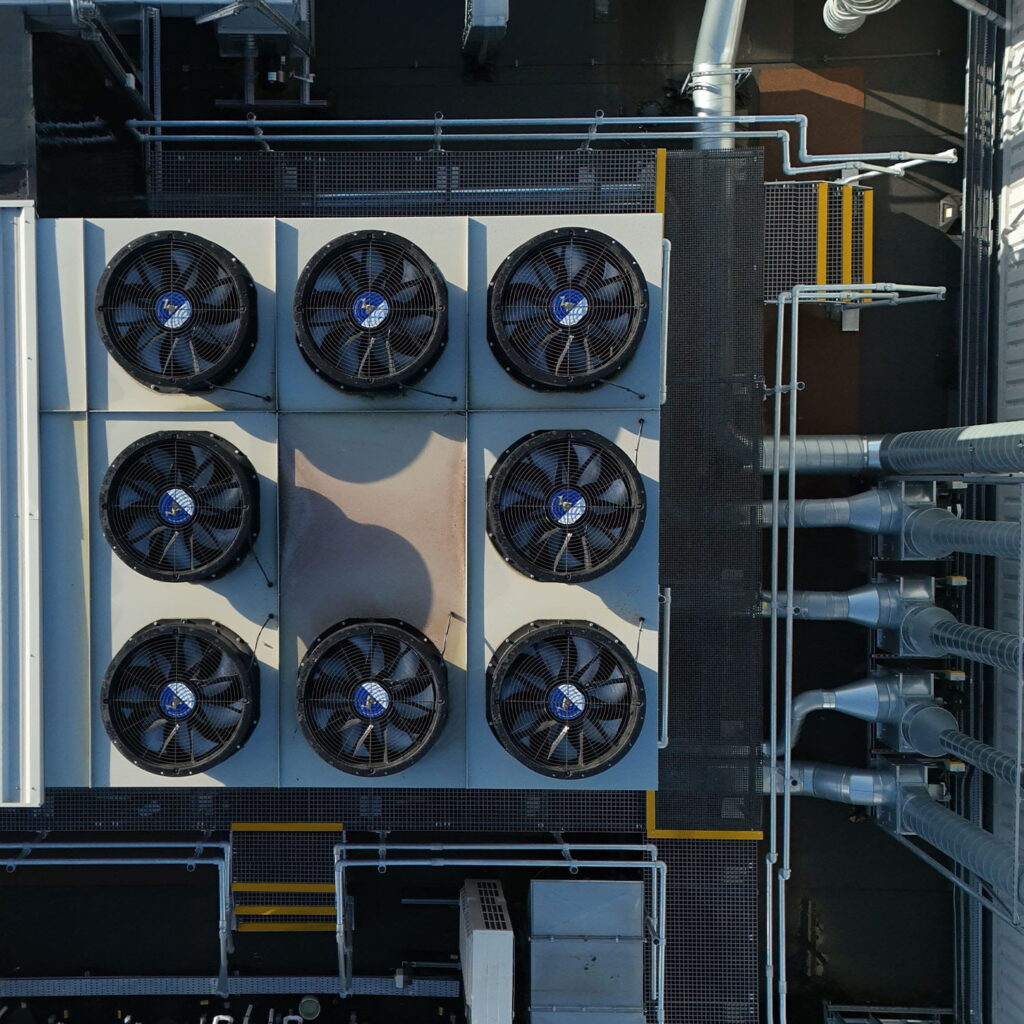
Aerial view of eight large industrial ventilation fans arranged in two rows on a rooftop, surrounded by pipes, metal gratings, and walkways.

Smarter Cooling, Not Simply More of It

The practical toolkit is well understood and mostly unglamorous.

Maintenance first. Heatwaves punish neglect. Blocked filters, fouled condensers, low refrigerant, and mis-set controls all cut cooling output at the precise moment demand peaks. Seasonal heat-readiness checks across critical sites, condenser and coil cleaning, leak detection and functional testing of fans and pumps prevent most failures before they start. Condition monitoring, tracking run-times, pressures and temperatures, flags an asset working too hard long before it stops.

Optimise what is already installed. Many systems still run on static setpoints that ignore both the weather and the grid. Raising office cooling setpoints slightly where it is safe to do so, pre-cooling thermally heavy buildings overnight, staggering chiller start-up to avoid coincident peaks, and easing non-critical cooling when the grid is tight all cut load without new plant.

Build in redundancy where it counts. When the UK last reached 40°C in July 2022, cooling failures forced Google Cloud and Oracle data centres in London offline; Google attributed its outage to the simultaneous failure of multiple supposedly redundant cooling systems. Critical loads need genuine N+1 or N+2 design, meaning one or two spare cooling units beyond what the load requires, with independent circuits to avoid common-mode failure, and failover that has actually been tested. In food retail, that can mean a mix of central plant and plug-in cabinets, portable backup, and a worked-out plan to move stock before it spoils.

Plan the lifecycle. Assets that cannot meet the temperatures now being seen should be first in the queue for replacement, with high-efficiency, lower-carbon systems chosen at the point of renewal rather than in a crisis. Refrigerant choice is now as much a compliance decision as an efficiency one: the proposed reform of the GB F-Gas rules points to a steeper HFC phase-down, so kit replaced today should move to lower-carbon refrigerants that will stay legal and serviceable across its whole life.

Start with the fabric. Policy bodies are clear that passive measures should come before mechanical cooling. External shading and shutters, reflective roofs, solar-control glazing, night ventilation and green infrastructure all reduce the heat that reaches the plant in the first place. External shutters alone are estimated to cut heat-related mortality by around 40%. FM is well placed to specify, install and maintain these measures, and to prove they work through temperature monitoring. The same logic applies at the plant itself: a chiller or condenser working against 25°C air runs far more efficiently, and fails far less often, than one fighting 35°C, so keeping heat away from plant rooms and condensers is one of the cheapest cooling gains available. In new-build housing, Part O of the Building Regulations already makes overheating mitigation, solar control, shading and ventilation a legal requirement, a marker of where standards are heading for the wider built environment.

The Business Case

 The cost of failure is rarely subtle. A convenience store that loses refrigeration in a heatwave loses its highest-margin chilled and frozen lines first. Ice cream and chocolate melt, stock goes to waste, and the aisle stays empty through the busiest trading days of the year. In one conversation with a grocery operator, the point was put plainly: an air conditioning fault or a blocked filter, left unmanaged, converts straight into lost product. A data centre outage cascades into customer downtime and, as July 2022 showed, into cancelled hospital appointments.

Set against that, proactive cooling resilience is cheap. Maintenance and optimisation reduce the chance of failure, smooth energy spend, cut carbon, and turn a volatile risk into a managed one. The business case is strongest when it counts avoided losses, not just kilowatt-hours saved.

The Next Frontier for FM

UK heatwaves are a structural shift, not a run of bad summers. They are straining cooling systems, pushing up demand and exposing weaknesses across supermarkets, data centres, hospitals and offices. National policy is starting to respond, but resilience is won or lost on the ground, in how well each estate is maintained, controlled and upgraded.

This is the same argument FM has been making about the energy transition, applied to cooling. Keep the assets healthy, optimise how they run, invest ahead of failure, and treat the building fabric as part of the system. The organisations that do this before the next 40°C day will keep their sites open, their stock intact, and their people safe. The future of cooling is smarter facilities management.

Keep Your Buildings Cool, Efficient and Resilient

Keep Your Buildings Cool, Efficient and Resilient

Explore OCS Energy Services

Share this story