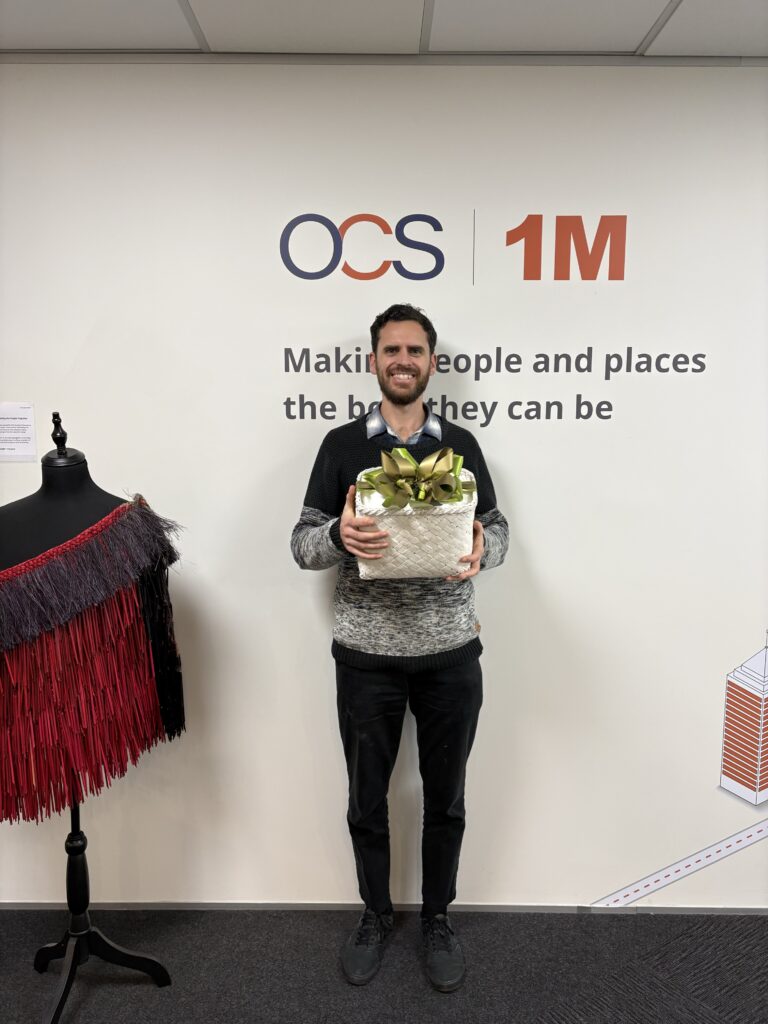
When Management Accountant David Brunton (Ngāti Kahu and Ngāi Tahu) completed the final module in OCS New Zealand’s Whiria te Ara learning programme, he felt that pieces of Aotearoa New Zealand’s story had finally fallen into place.
“I spent six months learning about aspects of New Zealand’s history, culture and customs that had never been fully explained to me before – so many light bulb moments.
“That’s why I made the effort to go each week – every day is busy, but I found real value in the sessions,” he says. “So, that’s why I decided that whatever I was doing on the day could wait.”
Earlier this year, we launched Whiria te Ara | Weaving the Journey Forward, a 23-part learning series developed with Mather Solutions as part of our wider Māori cultural capability strategy, Whiria te Tangata | Weaving the People Together.
The strategy was established to support our highly diverse workforce and build stronger understanding and confidence around kaupapa Māori, Te Ao Māori, tikanga and Te Tiriti o Waitangi across the organisation. OCS leaders also identified cultural capability as an important part of strengthening organisational identity, employee engagement and relationships with customers and communities.
Whiria te Ara was developed as the practical expression of Whiria te Tangata, our Māori cultural capability strategy. It introduced colleagues to a range of kaupapa Māori – subjects and ideas grounded in Te Ao Māori – including He Whakaputanga (The Declaration of Independence), Te Tiriti o Waitangi, te reo Māori, whakawhanaungatanga (relationship-building), wellbeing frameworks, and the tikanga (customs and practices) associated with pōwhiri (welcome ceremonies).
Learning the meaning behind the process
For many of our colleagues, the webinar series was the first time they had an opportunity to access learning, knowledge and kōrero/conversation around a range of kaupapa Māori topics.
For David, the kaupapa/programme answered questions he hadn’t realised he still had. While he had experienced many aspects of Māori culture throughout his life, the sessions deepened his understanding of why those customs exist and what they represent.
“I’d been through a pōwhiri before, but I never really understood why it happened the way it did,” he says.
“The sessions helped explain the meaning behind the process. It was also interesting to learn that tikanga can vary between different marae and iwi. There are broad principles, but there are also local differences.”
The programme also provided new perspectives on New Zealand’s history and society.
“It felt like I was learning about our country from a different perspective,” he says. “There were things I’d encountered growing up, but I didn’t always understand where they came from or why they mattered.”
The learning has influenced the way he thinks about his own role.
“Management accounting depends on relationships across the business,” he says. “Understanding people’s backgrounds and taking time to build relationships rather than treating every interaction as a transaction helps in my day-to-day work.”
Across the series, 70 colleagues took part. Each live module included online discussion, with recordings available to the wider team to learn at their own time and pace. Weekly learning questions were also sent out, giving participants another opportunity to consider and apply what they had heard.
More than a learning programme
Whiria Te Tangata describes a vision to create an organisation that is knowledgeable, confident, and connected to key aspects of Te Ao Māori, while ensuring OCS reflects the aspirations of the communities and people we serve.
That’s important in a business that works across government, education, health, transport, property and other sectors throughout New Zealand.
Every day, our colleagues work within customer sites and public spaces, interacting with people from a wide range of backgrounds and communities. Māori cultural confidence can influence everything from how relationships are established to how people participate in formal welcomes and community engagement activities.
As Dr Jim Mather explains, cultural capability is ultimately about understanding the context in which people work.
“A business can be technically competent and still misunderstand the community it serves.
“Cultural capability helps people understand the context they’re operating in. For OCS, that strengthens its identity as an Aotearoa business and supports better relationships with Māori colleagues, customers and organisations.”
The wider context reinforces the importance of that work. The original Whiria te Tangata strategy identified cultural capability as a way to strengthen employee engagement, support workforce diversity, enhance customer relationships and position OCS as an employer of choice.
What happens next
For David Brunton, completing the final module isn’t the end of the learning journey.
“I’ve got a lot more learning to do,” he says.
That’s exactly what Whiria te Ara was designed to achieve.
Rather than creating experts overnight, the programme aims to build Māori cultural understanding, confidence, relationships, and curiosity. For colleagues like David, that means seeing familiar experiences through a different lens. For OCS, it means turning the aspirations of Whiria te Tangata into everyday practice, one conversation and one relationship at a time.