
Data Centres | Energy Services

Sustainability and Uptime: the Real Test Facing Data Centre Growth

OCS Team

OCS Team

07 Oct, 2026

Sustainability and Uptime: the Real Test Facing Data Centre Growth

Data centres have become critical national infrastructure, and the pace of their growth will shape the UK’s digital economy for decades. How sustainably that growth happens depends as much on how these facilities are powered, built and operated as on how they are designed.

Those questions were raised during a recent roundtable on decarbonising the data centre, convened by The Engineer, which invited Oliver Sander, OCS’s Delivery Director of Data Centre Operations, to join operators, engineers and energy specialists in examining the challenge now defining the sector: expanding fast enough to meet demand while cutting environmental impact and maintaining the uptime that digital services depend on.


The Scale of the Challenge

The UK data centre sector is projected to be worth more than $11bn by 2027 and could account for as much as nine per cent of national electricity demand by the end of the decade. Regulators have warned that proposed developments may eventually require up to 50GW, more than the country’s current peak.

Meeting that demand will strain the grid. The network may need to roughly double in capacity by 2050. Individual sites are being proposed at up to 2GW, and demand at these facilities can swing by as much as 40 per cent within seconds, enough to stress the system at scale.

A Pipeline Moving Too Slowly

The discussion repeatedly returned to a UK pipeline moving more slowly than it should, held back by energy costs, grid constraints and planning complexity, while other markets press ahead. New designations and growth zones are meant to help. Whether their benefits reach the people delivering projects is another matter.

Sander put it plainly. A raft of legislation is coming to simplify planning, he said, “but actually getting it to the man or woman that’s sat there in the office, that’s a whole different kettle of fish”.

A man with dark hair and a beard wears a navy OCS shirt and orange lanyard, smiling in front of multiple security monitors displaying CCTV footage.
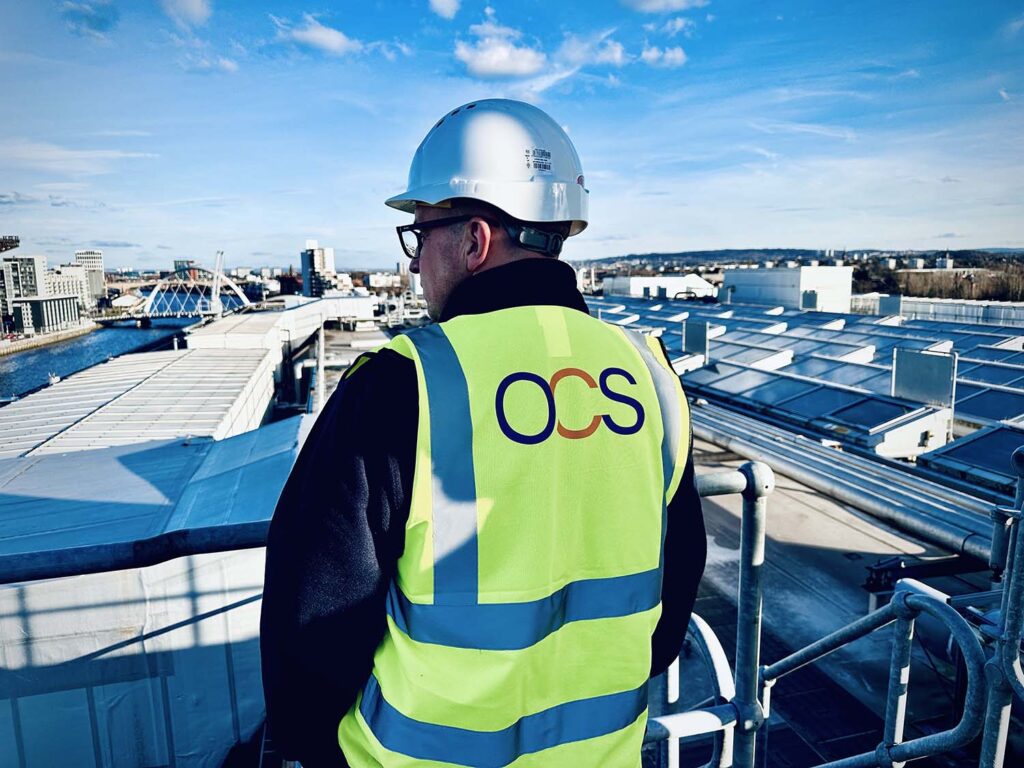
Two engineers in safety gear stand beside a laptop and equipment on a rooftop with solar panels, discussing work. A city skyline and blue sky with clouds are visible in the background.

The Skills Cliff-Edge

People are the constraint that touches everything else. Sander described a “skills cliff-edge” facing the sector. The average age of a data centre construction engineer is around 50, and by 2036 some 30 to 40 per cent of that workforce will have left. Experienced electrical engineers are already scarce and expensive. Cable jointers are even more so.

“If you want to be a millionaire in a couple of months or years, become a cable jointer,” Sander said.

Poaching between employers does not grow the pool, and the sector will have to bring in new people and train them faster. AI and immersive training tools were presented as part of the answer, capturing hard-won knowledge and putting trainees through more scenarios in less time.

Retrofit and the Spread Beyond London

One of the clearest routes to new capacity is not a new build at all. “Power and planning are major challenges for data centre operators,” Sander said. “Being able to take an existing site and repurpose it or upgrade it reduces the risk of delivery because you don’t have to worry so much about planning.”

Converting suitable industrial buildings into data centres avoids much of the planning uncertainty that stalls new projects, and it is where OCS does much of its work.

The geography is shifting too. Activity that once concentrated around London and the M4 corridor, which Sander called “data centre alley”, is spreading north. That eases pressure on the busiest parts of the grid and spreads investment more widely.

The supply chain is changing with it. Smaller specialist contractors are giving way to consolidation, or, as Sander put it, “the great consolidation feels like it’s starting”. Buyers are maturing from using anyone who can supply a part towards fewer, deeper partnerships focused on getting components to engineers quickly and keeping facilities running.

Local Value and Wasted Heat

Public concern is mounting over facilities perceived as power-hungry and remote from the communities that host them. The panel agreed that the strongest answer is local value, with waste heat the obvious example.

Almost all of the electricity a data centre draws leaves the building as heat, and most of it is simply discarded. If recovered and piped into homes, pools and public buildings, that heat could warm large numbers of households and turn a nuisance into a benefit.

The barrier is rarely engineering. It is planning, process and the time it takes to get anything approved.

A modern data center hallway with glass walls on one side, revealing rows of illuminated server racks and computer equipment glowing with blue lights. The space is clean, high-tech, and well-lit.
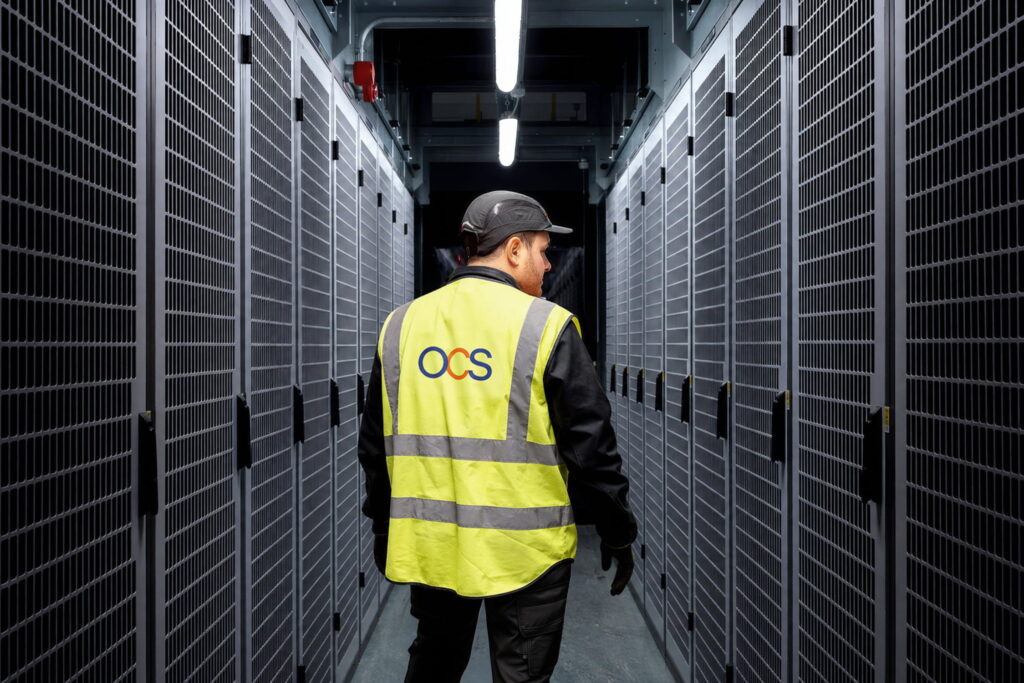
A person in a yellow OCS safety vest and black cap walks down a corridor between server racks in a data centre, illuminated by overhead lights.

Measuring the Right Things

Sustainability is broader than the electricity bill. Established metrics such as Power Usage Effectiveness remain useful, but they say little about heat reuse or water, and there is a fair question about whether performance should be judged hour by hour rather than once a year.

Embodied carbon is the bigger blind spot. Much of a data centre’s carbon footprint is locked into its equipment and structure before it processes a single byte.

The underlying problem is incentives. The industry tends to optimise for cost rather than carbon, so the task is to make the lower-carbon option the lower-cost one. On current evidence, that gap is starting to close.

What Comes Next

On technology, small modular reactors featured prominently as a way to provide a major campus with low-carbon power, though the planning hurdles are significant. Sander pointed to liquid and refrigerant cooling, which will matter more as AI pushes power densities higher. Other ideas ranged from AI-designed chips to direct air capture and photonics, innovations that are already here, if unevenly spread.

On whether the sector can grow sustainably, the mood was cautiously optimistic and clear-eyed about what will drive it. “It won’t be the goodness of hearts. You’ve got shareholders. It’s going to be forces,” Sander said. “But it feels like government has to have a hand in shaping the direction.”

If one message ran through the day, it was this: data centre decarbonisation is now an energy story, an infrastructure story, a skills story, and increasingly, a sustainability story. The engineering answers are emerging. The harder task is deploying them fast enough and building the workforce to run what gets built.

Discover OCS Data Centre Services

Discover OCS Data Centre Services

Explore Data Centre Services

Share this story