Facilities management in Indonesia is becoming a more strategic business priority. As organisations respond to growing expectations around resilience, compliance, workplace performance, sustainability and risk, FM is moving beyond day-to-day service delivery.
Under the leadership of Yohanes Jeffry Johary, President & Managing Director of OCS Indonesia, OCS is helping connect Indonesia’s operational needs with international standards, professional networks and future-ready FM models.
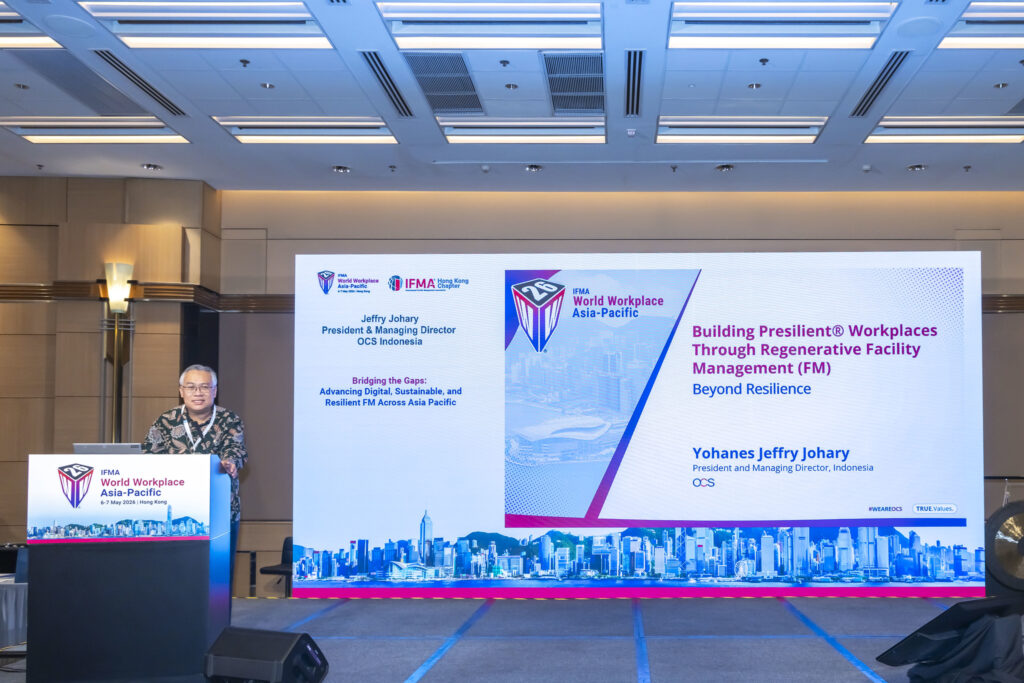
Jeffry’s participation at World Workplace APAC in Hong Kong provides the starting point for this conversation. The wider focus is how OCS Indonesia is contributing to the development of the country’s FM ecosystem through IFMA, regional collaboration and Regenerative FM; an approach that positions facilities as business-critical assets that support operational performance, people, communities and environmental outcomes.
In this conversation, Jeffry shares how OCS Indonesia is helping bring Indonesia’s FM voice into regional and global industry discussions, and why Regenerative FM matters for the next phase of the profession.
As President & Managing Director of OCS Indonesia, what did it mean to represent OCS and Indonesia’s FM sector at World Workplace APAC in Hong Kong?
“World Workplace APAC is part of IFMA’s global series, bringing together facilities management professionals from different markets. For OCS Indonesia, being part of this platform was an opportunity to represent the growing maturity of Indonesia’s FM industry on a wider regional and global stage.
Through our participation, including the keynote on Regenerative FM, OCS Indonesia contributed a practical perspective from Indonesia into broader discussions around workplace performance, resilience, sustainability and the future direction of facilities management.
It was meaningful to see Indonesia increasingly recognised as part of the future of FM in Asia Pacific. The country has scale, complexity and strong growth potential. As Indonesia continues to develop, FM will play an important role in supporting organisations, workplaces and communities more effectively.”
Yohanes Jeffry Johary
President & Managing Director of OCS Indonesia
OCS Indonesia has been part of wider conversations around the future of facilities management. How has your role as an OCS leader helped bring Indonesia’s FM voice into regional and international industry discussions?
“My role has been to help connect Indonesia’s operational realities with global professional standards and strategic industry conversations.
Indonesia is a dynamic market, with a large workforce, complex operations, rapid urbanisation and increasing ESG expectations. Through IFMA, regional forums and industry collaboration, OCS Indonesia is bringing practical perspectives from the ground while learning from more mature FM ecosystems.
The intention is not to position Indonesia as a follower. It is to show that Indonesia can contribute to how FM evolves in emerging markets. With the country’s scale and opportunity, Indonesia can become an important voice in shaping the future of the profession.”
What developments have you seen in Indonesia’s FM sector that made stronger professional collaboration, including the formation of the IFMA Indonesia Chapter, necessary at this time?
“The FM industry in Indonesia has become significantly more complex. Organisations are now expected to manage workplace experience, compliance, sustainability, technology integration, operational resilience and workforce capability at the same time.
This level of complexity cannot be addressed by individual companies working alone. A stronger professional platform is needed to develop capability, build leadership continuity, share standards and support industry maturity.
That is why the formation of the IFMA Indonesia Chapter is important. It creates a platform where operators, customers, educators, technology partners and professionals can contribute to strengthening the FM ecosystem together.”
How has OCS Indonesia contributed to creating the conditions for stronger FM capability, standards and leadership continuity in the country?
“OCS Indonesia has always focused on helping people and places be the best they can be. In Indonesia, the development of people is closely connected to the development of communities, workplaces and the environment.
Over the past few years, OCS Indonesia has focused on four connected elements: people, community, workplace and environment. These priorities are not separate. When people are supported, communities benefit. When communities are stronger, workplaces become more stable. When workplaces are better managed, organisations can operate more effectively and responsibly.
This thinking has shaped our approach in the market. OCS Indonesia operates with commercial discipline and a strong social mindset. We describe this as a hybrid enterprise model, developed through practical experience and refined over several years.
From this model, we introduced Regenerative FM to support the development of regenerative workplaces.”
What does Regenerative FM mean to the organisation, and why is it relevant to Indonesia now?
“Regenerative FM means moving beyond maintaining operations towards strengthening the systems that allow organisations to perform sustainably and with impact over time.
Compliance is the foundation. It ensures requirements are met. Resilience is the next level, helping organisations recover and respond when disruption happens. Regenerative FM goes further by focusing on anticipation. It asks how FM can help organisations prepare for future pressures, not only respond to current ones.
Since 2023, OCS Indonesia has been developing this approach by bringing people, community, workplace and environment into one connected system. In many FM models, community is treated as external. In Indonesia, people and community are inseparable. Community and workplace are also closely linked.
This makes Indonesia a relevant market for Regenerative FM. The country is growing quickly while facing pressure around workforce capability, urbanisation, environmental sustainability and operational resilience. FM can help organisations adapt to those realities in a more responsible and strategic way.”
Why were people, community, workplace and environment chosen as the four pillars of Regenerative FM?
“The people we hire often come from the communities around the sites we serve. If we want to create long-term impact, we need to support people through mindset development, upskilling and stronger work readiness. When they return to their communities, that impact continues.
Community engagement is therefore an important part of workforce resilience. A stable workforce needs the support of the community around it.
People come from the community. They work in the workplace. The workplace includes the customer’s assets, infrastructure, digital systems and processes. The environment is also part of that system, because environmental responsibility is now central to how organisations think about ESG and long-term value.
Together, these four elements form the foundation of Regenerative FM and support the development of regenerative workplaces.”
Looking ahead, what role do you see OCS Indonesia playing in advancing the FM profession, both locally through IFMA Indonesia and internationally through platforms such as World Workplace APAC?
“OCS Indonesia will continue helping bridge operational practice with professional development, international collaboration and system-level thinking.
Locally, through the IFMA Indonesia Chapter initiative, the focus is on strengthening capability, standards, leadership continuity and practical collaboration across the FM ecosystem.
Internationally, platforms such as World Workplace APAC allow Indonesia to contribute perspectives from an emerging market into wider industry conversations.
The goal is to help position FM as a strategic discipline that strengthens workplaces, organisations, communities and long-term resilience. OCS Indonesia will continue bringing this perspective into larger global platforms and contributing to the future development of the profession.”