
Resilience Week 2026

Mentoring: A Small Action with a Lasting Impact on Wellbeing

OCS Team

OCS Team

02 Jun, 2026

Mentoring: A Small Action with a Lasting Impact on Wellbeing

A regular conversation with someone who has been there before may not feel like a wellbeing programme. It is one of the most powerful ones we have. 

Across facilities management, people work in demanding environments. Shift patterns reshape the rhythm of life, and customer expectations move quickly. Teams sit in hospitals, airports, schools, data centres and front-of-house desks, often without seeing the same colleagues twice in a week. In that context, wellbeing is rarely built by a single intervention. It is built through hundreds of small relationships, check-ins and quiet moments. Mentoring is one of the most reliable of those. 

A Different Kind of Mentoring Conversation

When colleagues hear the word “mentoring”, they often think of career progression: how to get the next role, how to build the right skills, how to map a future. That kind of mentoring matters. It is not the only kind. 

Wellbeing mentoring sits alongside career mentoring. It focuses on how a person is coping, not just where they are heading. It offers a trusted space to discuss workload, pressure, confidence and the everyday realities of a demanding job. It works alongside professional support, offering a steady voice between the formal channels. 

The aim is simple. To help colleagues stay calmer, clearer and more supported in roles that ask a lot of them. 

A woman wearing an orange work uniform and black gloves is crouching and trimming bushes in a garden. She is smiling at the camera and surrounded by greenery on a stone path.
Two people in matching dark suits with OCS logos, standing outdoors and smiling at each other, with greenery and trees in the background.

Why This Matters Now

A generation of people began their careers during the pandemic. For many, the first years of work were shaped by remote starts, hybrid handovers and far fewer of the informal moments that quietly build confidence in a new environment. The result is real. Newer colleagues have had less of the over-the-shoulder learning, quiet observation and unplanned conversation that earlier generations took for granted.  

Mentoring can recreate some of what was lost. A regular session with an experienced colleague gives junior colleagues somewhere to ask the questions they would rather not ask in a team meeting. It is a place to talk about a growing workload before it becomes a problem. It is a place to be reminded that the early jitters of a job are normal and pass with time.

For colleagues returning after a career break or stepping into an unfamiliar environment for the first time, mentoring offers a structured way to feel less alone in the change. 

Mentors as a Steadying Voice

Research is clear that mentoring relationships are associated with lower burnout, stronger belonging and higher job satisfaction. The mechanism is not complicated. People feel heard. Stress gets discussed instead of being carried in silence. Practical strategies replace a loop of repetitive, negative thinking. Confidence builds because someone has watched it build before and can describe how. 

For our leaders and managers, the takeaway is just as clear. Investing in mentoring is investing in the conditions that allow colleagues to do their best work. It is part of the soft infrastructure of a resilient business. 

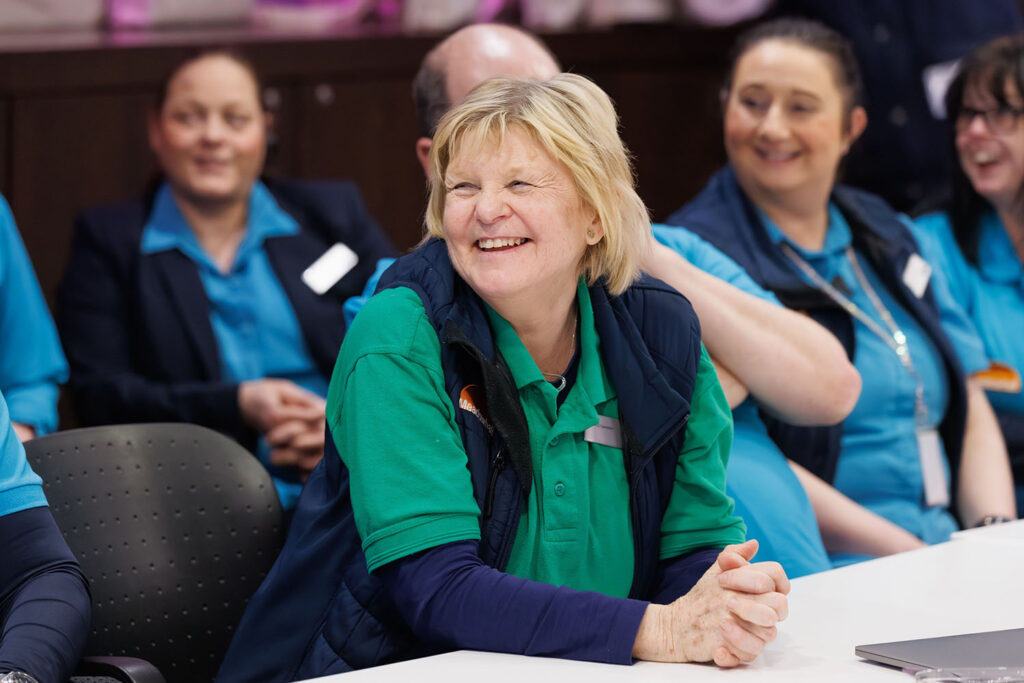
A group of people in uniforms sit together at a table, smiling and laughing. The focus is on a woman in a green shirt and blue vest who is smiling brightly. Others around her also appear happy and engaged.
A smiling woman in a navy blue uniform with red trim is mopping a bright, clean hallway. She appears happy and focused on her work. The hallway is well-lit with blurred signage and caution signs in the background.

UK in Focus: Mentoring Circles in Security

On 6th March 2026, OCS hosted its Women in Security event at Capital One UK’s headquarters in Nottingham, bringing colleagues together from across security operations. The day surfaced honest dialogue about progression, recognition and the everyday culture of the sector. 

It also produced action. OCS launched Mentoring Circles at the event itself, with senior female leaders running group mentoring sessions for women in security at every level. The group model was chosen for a practical reason. There are not enough female mentors in the industry to support every woman one-to-one. Circles extend that capacity. The first cohort will run for five to six months. If the model holds, it will be scaled further. 

The launch on the day was deliberate. Mentoring as a wellbeing intervention is most credible when it begins immediately, not when it lives in a future-state plan.  

APAC in Focus: Building Confidence for Critical Environments in India

Data centre operations run 24 hours a day, seven days a week. The pressure is constant, the margin for error is small, and walking into that environment without adequate preparation is, for many, genuinely daunting. 

OCS India partnered with a vocational training institute in Mumbai to address that directly. A 90-day Data Centre Facilities Management course places trainees in a live simulation lab before moving them into real operational environments, with experienced industry practitioners alongside them throughout. 

The structure matters as much as the curriculum. Feeling underprepared is one of the more reliable drivers of workplace stress, particularly in environments where the consequences of getting it wrong are visible and immediate. Knowing someone more experienced is watching, invested in your progress and willing to answer the questions you would rather not ask in a group, is what turns technical training into lasting confidence. Colleagues who feel prepared handle pressure differently. The career pathway runs from Trainee to Facility Manager. The mentoring is what makes it navigable, and that sense of being guided rather than thrown in, is one of the quieter ways wellbeing gets built. 

A woman with blonde hair and glasses, wearing a navy blue polo shirt, stands smiling with arms crossed in front of electric vehicle charging stations in an outdoor parking area.
A smiling maintenance worker in a blue uniform wipes a countertop at an indoor facility, with golf clubs and multiple screens visible in the background.

A Two-Way Wellbeing Engine

The benefits of mentoring travel in both directions. Mentors often report a renewed sense of purpose, stronger engagement and a clearer reminder of why they joined the industry in the first place. They reconnect with the parts of the job they enjoy most. They see their own experience valued. Mid-career and senior colleagues, particularly those who carry a heavy load, can find mentoring a steadying presence in their own week.

When mentoring is designed well, with clear boundaries, training and recognition for those involved, it strengthens the whole team. It models the behaviours that build psychological safety. It demonstrates, in practice rather than in policy, that OCS takes care of its people.

Small Actions. Big Impacts.

Resilience Week 2026 carries one clear message. The small actions we take with each other, every day, build the resilience the business depends on. 

Mentoring is one of those small actions. A coffee. A phone call. A short conversation between shifts. None of these moments are dramatic in isolation. Together, they form the connective tissue that helps colleagues stay calmer in pressure, clearer in change and more confident in who they are at work. 

Wellbeing has never lived in a single programme. It lives in the people who notice, listen and steady each other. That is what mentoring offers. Used well, it is one of the quiet ways OCS keeps showing up for its colleagues, customers and communities, in every country we work. 

Building Resilience Through Connection

Building Resilience Through Connection

Visit Resilience Week 2026

Share this story